Archive for the ‘making a difference’ Category

Breast Cancer (Body Count – Part II)

Friday, November 2nd, 2012

As explained previously, different governments use the expression Body Count to update the public on the number of violent deaths that occurred because of war or military action. These reports may be given daily, weekly, monthly or yearly. Since a number of deaths occur in North America because of unhealthy habits we want to remind the public how many people die daily, weekly, etc. due to engaging in these potentially dangerous risk factors (sedentary behavior, poor diet, smoking, etc.).

The Numbers
Lack of physical activity (or lack of exercise, if you prefer) is a major risk factor in breast cancer. Currently in North America (U.S. & Canada) lack of physical activity may cause as many as 1 in 4 breast cancer deaths.* Let’s translate that information to real Body Count deaths:

  • Annually, breast cancer claims 44,665 lives. Of these deaths, 12,417 are due to a lack of exercise.
  • Each month, breast cancer claims 3,722 lives. Of these deaths, 1,034 are due to a lack of exercise.
  • Every week, breast cancer claims 859 live. Of these deaths, 239 are due to a lack of exercise.
  • Every day, breast cancer claims 122 lives. Of these deaths, 34 are due to a lack of exercise.

Let’s Look At This Another Way**
Breast cancer claims a life every 42 minutes due to physical inactivity.

What’s the Connection?
I’m glad you asked. Above I cited that 12,000 people die annually from breast cancer in North America because they do not get enough exercise. The role of exercise in reducing breast cancer risk is based currently on two possible factors. The first is that physical activity helps reduce the amount of undesirable weight and/or body fat. Higher levels of obesity are associated with breast cancer risk. The second factor may be a hormonal connection. Regular physical activity is known to reduce levels of estrogen, testosterone and insulin. Higher levels of these hormones predispose a person to increased breast cancer risk. Using insulin as an example, Dr. Celia Byrne and her associates at Harvard University discovered that increased C-peptide (an insulin production marker) levels are higher in women with breast cancer. Interestingly, however, women who exercise on a regular basis have lower levels of C-peptide suggesting that physical activity decreases insulin levels and therefore breast cancer.

An Easy Fix
Lack of physical activity is an easy fix. To reduce the risk of breast cancer through physical activity, 150 minutes of moderate-intensity aerobic physical activity during the week (50 minutes 3 times a week or ~37 minutes 4 times a week—that’s 1-1/2% of your 24 hour day) does the trick. Even if you can’t squeeze in the 150 minutes/week learn to build physical activity into your life. Never lie down when you can sit. Never sit when you can stand. Never stand when you can walk. Never walk when you can run, bike, swim, jog, jump……..

*Lee, I, Shiroma, EJ, Lobelo F. et al. The Lancet, Published online 7/18/12

**© 2012, Fitness Finders, Inc. Permission granted to use provided recognition is given to Fitness Finders, Inc (1007 Hurst Rd, Jackson MI, 49201)

Body Count (Part 1)

Friday, October 19th, 2012

The U.S government (and other countries) use the expression Body Count to update the public on the number of violent deaths that occurred because of war or military action. These reports may be given daily, weekly, monthly or yearly. Since a number of deaths occur in North America because of unhealthy habits we want to remind the public how many people die daily, weekly etc. due to engaging in these potentially dangerous risk factors (sedentary behavior, poor diet, smoking, etc.).

An American Epidemic
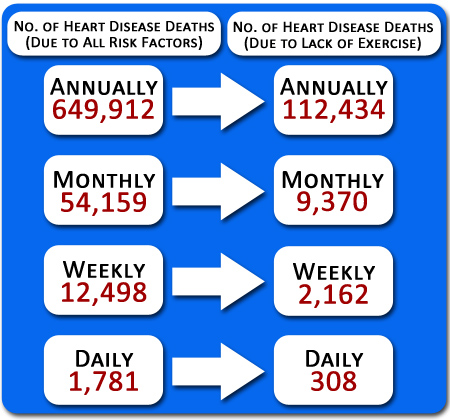
Lack of physical activity (or exercise, if you prefer) is a major risk factor in heart disease. Currently in North America (U.S. & Canada) lack of physical activity may cause as many as 1 in 6 heart disease deaths.* Let’s translate that information to real Body Count deaths.

The Numbers
Body Count
Think about the realities of these numbers. Almost 112,500 people die in North America because they live a lifestyle that lacks exercise. Imagine the public uproar if that many people died annually from auto accidents, excessive alcohol consumption or being shot with a gun.

An Easy Fix
Lack of physical activity is an easy fix. To reduce the risk of heart disease through physical activity, 150 minutes of moderate-intensity aerobic physical activity during the week (50 minutes 3 times a week or ~37 minutes 4 times a week—that’s 1-1/2% of your 24 hour day) does the trick. How does lack of sedentary behavior increase our heart disease risk? Not getting sufficient exercise may encourage an increase in obesity/overweight and abdominal fat, development of undesirable blood cholesterol profiles, elevated blood pressures and triglyceride levels and a predisposition toward type 2 Diabetes. Get moving!

*Reference: Lee, I, Shiroma, EJ, Lobelo F. et al. The Lancet, Published online 7/18/12

360,000,000 Minutes of Activity a Year!

Tuesday, October 16th, 2012

The power of the teachers using the Mileage Club® to help fight youth obesity and help get Americans moving is truly amazing. Here’s why.

The Numbers
Each year we have at least 10,000 schools committed to using the Mileage Club. There are approximately 275 children per school. Our local project, started in 1986 (consisting of 30-32 schools), for example, has shown over the years that in an 8 to 10 week period of time (2 to 3 x a week) the typical child walks/runs 11-15 miles. We have found these distances to be characteristic of other Mileage Club schools. Now, using this as a conservative sample (many schools run the program more than 10 weeks), let’s say the normal child walks/runs a mile in 12 minutes. These numbers show some extraordinary results.

Let’s Do the Math

  • 10,000 schools x 275 children = 2,750,000 children each year engaged in the Mileage Club.
  • 2,750,000 children x 11 miles = 30,250,000 miles a year.
  • 30,250,000 miles x 12 minutes = 363,000,000 minutes of exercise per year!

In Perspective
1,200 Laps Around the Planet.
More Students Participating in Mileage Club than People that Live in Chicago.
Students had a Combined Exercised Duration of 690 Years.

WOW! That Is Impressive.
Thanks to all physical education and classroom teachers, principals, playground supervisors, parents (especially PTA/PTOs) for your incredible support in helping us all Shape America’s Youth. You have been fabulous.

Feelin Good® Mileage Club® Continues to Make News!

Thursday, January 26th, 2012

Check out how one of our customers is having an impact in St. Louis.

Teacher’s Mileage Club Gets Students Moving

Has anything changed since 1996?

Tuesday, January 24th, 2012

Who remembers Luther Terry?

In June of 1962, Surgeon General of the U.S. Luther Terry called a group of experts together to review the connection between smoking and “the epidemic rise of lung cancer.”  In 1964 Terry (while smoking a pipe) released his committee’s findings which “hit the country like a bombshell.”

The report stated that smoking kills.  The report revealed that cigarette smoking was responsible for a “70 percent increase in the mortality rate of smokers over non-smokers. The report estimated that average smokers had a nine- to ten-fold risk of developing lung cancer compared to non-smokers: heavy smokers had at least a twenty-fold risk.”  Terry’s report left its mark.  “A Gallup Survey conducted in 1958 found that only 44 percent of Americans believed smoking caused cancer, while 78 percent believed so by 1968.”

So what?

Right now, you are thinking, “the link between tobacco and cancer is common sense, why don’t you tell me something I don’t know?”  Ok, I will.  In the summer of 1996, then Surgeon General Audrey Manley released her own ground-breaking report called “Physical Activity and Health: A Report of the Surgeon General.”  It was called, “a landmark review of the research on physical activity and health.”  (While the Surgeon General was fit and trim, as she released the report, most of the other leading government dignitaries standing with her were overweight or obese).  Hmmm, the more things change the more things stay the same.

This truly outstanding report had powerful information.  It indicated that regular physical activity reduces the risk of dying from heart disease, complications related to diabetes and high blood pressure. It also noted that exercise helped reduce the risk of low back pain and weight gain.  At the time of the report’s release the leading cause of death in the United States was heart disease.

So where are we now?

Since the 80’s, the CDC has listed the three main risk factors for developing heart disease as obesity, lack of regular exercise and smoking (this remains true today).  For most people all three of these risk factors are connected to lifestyle choices. Sadly, the leading cause of death has gone unchanged since Manley’s report. In fact, things have gotten worse. The rate of obesity has increased with leaps and bounds and the amount of Americans not getting enough exercise has decreased only slightly.  Currently, the percentage of Americans not getting sufficient levels of exercise is around 62%.

The connection

After Luther Terry’s 1964 report public opinion about smoking slowly started to change.  The public became aware of the dangers of smoking. Negative advertising toward smoking, the stopping of advertising tobacco products on TV and elsewhere, warnings of the health dangers on tobacco products, substantial evidence showing the incredible health challenges that tobacco products create are just a few of the things which brought about change.

The most significant wallop against smoking occurred with the realization of the dangers of second-hand smoke.  Soon people were restricted from smoking on planes and then in selected businesses and restaurants. Today, smoking is not permitted, in virtually all public places. Many states heavily tax tobacco products further giving tobacco products “persona non grata” status.  Smoking is no longer “cool”.  We have created an environment in which smoking is actually a hassle.

Our current situation (the obesity epidemic)

Despite similar origins (Surgeon Generals reports), condemning research and cultures which have changed (at one time it was hip to smoke and fat was a sign of success; now non-smoking and being active are stylish) why hasn’t Manley’s report had the same effect as Terry’s?  I think it’s because we have not made serious efforts to change the actual environment.  In the past 30 years we have been raising a couple of generations of very fat kids, who will and/or have become even fatter adults.  How did this happen?

  1. Parents shuttle their kids between home and school to gymnastics, soccer etc., etc., etc. to get exercise. In reality these are scheduled exercise sessions in which some kids play and others do not.  It is not the “free play” of past generations where kids played outdoors all four seasons expending real energy.
  2. Physical education programs have been reduced or eliminated
  3. Many recreation programs have disappeared
  4. Children are chauffeured almost everywhere
  5. Playground time is eliminated
  6. Kids rarely ride or walk to school.
  7. Free play after school is curtailed till parents get home.  In the 21st century free time is screen time.
  8. The average child drinks 2-12 ounce cans of soda pop a day
  9. School canteen and vending machines abound
  10. Even children who come from impoverished neighborhoods are obese.  In fact, they may suffer from more obesity than other populations.
  11. Research shows that most parents do not see their children as overweight

I could add 10 more items and the list would not be exhausted.  Because of the above, the average child burns off about 400-600 fewer calories than did children of 70 years ago.  Not good, 400 to 500 fewer calories a day amounts to 40 to 50 pounds a year!

That is why we have been unable to “jump start” getting kids to move.  The tobacco effort centered their successful effort on changing the environment.  With physical activity we have changed the environment to make kids more sedentary and eat the wrong kinds of food.

We (health professional, government leaders and parents) have failed in the drive to get children active and drop excess pounds.  We need programs, facilities, and environments which encourage the learning of physical skills for all children.  We need to provide school, club, community and home environments to help kids be truly active.  We need less talk and more action.  We need leaders who are willing to do something worthwhile, not just mouth words. We need a nation that will face the difficult tasks of requiring people, starting with children, to learn how to be responsible about their health.  This will not be an easy fix.  In fact, it will be extremely challenging

Post Note: Were you offended in paragraph 3 that I called many of the government dignitaries overweight and obese?  Why?   It didn’t seem to matter that I ridiculed Luther Terry (paragraph 1) saying he smoked as he gave his report.  Let’s get honest as a nation.  We have a problem.

Weight Loss Folly

Wednesday, January 11th, 2012

One thing that has aggravated me during my 49 year career in physical activity, fitness, nutrition and healthy living study and research is the fixation people have with the latest diets, exercise regimens and mind control tactics to lose weight.  Since the early 60’s the American public has been deluged with diets which include low carbohydrate, low fat and low protein diet plans.  More recently we have been bombarded with plans that consider your carbs, gender, age, body type, metabolic circumstances and…you fill in the blanks.

Sadly, these fixations and promotions of weight loss plans have been a dismal failure.  I once told a colleague that we (the health promotion profession) have failed the public miserably on delivering the goods with effective weight control plans.  She was terribly agitated with me.  She noted her agency had developed really good and effective programs.  My retort was that the programs and intiatives may be good in theory, but they are not effective.  Most people are unable to keep the unwanted pounds and fat off their bodies for a lifetime.  She got so mad at me that she refused to talk to me and actually tried to sabotage some of my research and credibility.  Talk about drama and failing to read the tea leaves.

In the 15 years since our argument, things have gotten a lot worse.  There are more programs, more books, more information on the net and more government intervention.  The result of these supposedly “good and effective”  programs is that we are fatter and more bedeviled with wieght than ever before.  To compound the problem we have exported the weight problem to the world.  Experts call obesity and the resulting Type 2 Diabetes the “Black Death of the 21st Century.”  Scary.

My former colleague had her head in the sand.  Sadly, so has the public.  For example: In 2010, 84% of U.S. parents thought their child was at an ideal weight.  In reality almost 33% were classified as over weight or obese.  And the parents/adults are not doing any better.  One third of people are at least 30 pounds overweight.  And the projections are that by 2030 around 50% of the U.S. males and females will reach 30 pounds overweight.

So how can anyone say we are effective?  We are losing the war on obesity and overweight among children and adults.

Why?  When it comes down to it no one is really serious about correcting the problem.  That’s because we need to think not just about a 10 minute a day work-out, cutting carbs or whatever.  We need to think long-term – a lifetime.  Fighting obesity is a 100 year project.  This is thinking differently about what you do and who you are.  It starts prenatally and continues till you are laid to rest.  There is no alternative.  Short term thinking produces short term results.

When you have time, I would like your thoughts on how we, as a profession, can fight the new Black Death that is sweeping the world.  I’ll post those which I think provide compelling thoughts for us to consider.  Your thoughts may focus on you family, classroom(s), state, nation or the world.

Best, Charlie

Do Bully-Free Zones work?

Wednesday, January 4th, 2012

An establishment down the road from my home has a sign at the front entrance announcing that it is a “Nuclear Free Zone.” I am not sure what that means. Questions that come to mind are:

  • Are visitors who carry nuclear products in their pockets immediately rejected by an invisible Nuclear-Free fence? (I guess that would be a good reminder for those who are in the habit of carrying nuclear items. Check your pockets prior to entering.)
  • What happens if an individual with nuclear material happens to make in on the property? Does the nuclear material suddenly disappear, or does it explode?
  • In case of a nuclear bombing, will the nuclear waves not penetrate this area? Sign me up!

In the same way, the statement that a specific school is a Bully-Free Zone just creates questions.

  • Are bullies immediately rejected when they hit the invisible Bully-Free barrier?
  • What if a bully does make it into the zone? Does the bully now become a nice person?
  • What happens if someone does bully another within the zone?

Too frequently, Bully-Free signs are posted without proper programs or education for all involved parties. The belief – by posting a Bully-Free sign, bullies will turn and run, or simply decide not to bully any more.

Posting a Bully-Free sign is simple to do. Let’s make sure we have policies and programs in place to substantiate such a declaration.

School Mileage Clubs Making News

Friday, December 2nd, 2011

Here are some links to news articles about schools that are making a difference using our Mileage Club.  See what others are doing and make it work for you!

   Smith Valley School in Montana

   Wheeler Avenue School in New York

   Campbell Elementary School in Michigan

   South End Elementary School in North Carolina

We want to hear from you!  Leave your comments below.

How Brain Research Can Change the Way We Develop Youth Programs

Friday, November 18th, 2011

Dr. Paul Zak, professor of Economics at the University of Pennsylvania, has taken a unique approach to the study of character and morals.  His question, basically, is “what is the biological basis for trust?”  If you are interested in hearing it straight from the horse’s mouth, his discussion of this research at the TED (Technology, Entertainment, Design) convention from the summer of 2011 can be viewed here.  http://tiny.cc/bsk45

To summarize his findings, he demonstrated not only a relationship, but a cause-effect relationship between the hormone oxytocin and our willingness to trust.  Oxytocin is present in the body in very small quantities-except in the case of the late stages of pregnancy, where it prepares the mother’s body to be able to breastfeed.  Zak showed that, when people were asked to trust someone in a financial situation, those with more oxytocin in the blood were more trusting.  Furthermore, he was able to introduce oxytocin (through a nasal spray) and increase the trusting nature of people in these situations. 

Why would a hormone that allows mothers to feed their babies lead to more trust?  Perhaps there is a common thread in that both are related to creating a significant connection between people.  Oxytocin, and therefore trust, increases when connections are formed:  hugs, holding hands, prayer, weddings and even social media connections with significant others lead to more of this chemical.  Stress and testosterone are two of the biggest inhibitors of this hormone.  It is commonly cited that the one trait that successful youth share is growing up eating at the dinner table with the family most nights.  Close families are also empirically found to share in common the choice of camping for recreation, again as a family.  Maybe there is a relationship here?

Is the opposite occurring with our youth who are becoming disconnected, spending most of their time engaged in technology, sometimes shared with others, but often alone with the television, the computer, or the cell phone?  Couldn’t we expand our research to include this group, looking at oxytocin levels in our more isolated youth?

This brings me to the question, “How do we increase trust and other character building traits in our youth?”  In addition to education using Character Counts or Character Bound programs, shouldn’t we include activities that foster community and connections with others to nurture an environment, in the brain, where trust and possibly other character traits can develop?  If the chemical underpinning of trust is oxytocin, let’s make sure we have enough of it for trust to form.  Just like we make sure we have enough protein when trying to build muscles through strength training.

I don’t have these answers, but together we can explore some ideas.  What ideas can we come up with, what tactics can leaders of youth employ, to increase these connections?  Share your ideas in the comments section below, or e-mail me at shapingamericasfuture@fitnessfinders.net.  I will take your ideas and mix them with ours here at Fitness Finders so we can discuss this idea of priming the brain for character development.

You Are a Difference Maker

Monday, February 28th, 2011

Sorry to be absent from the blogging world for so long. Life has a way of getting away from us.

Speaking of life getting away from us, we are in the midst of state and federal budget debates across the country. Uncertainty is the common thread in schools and programs everywhere you turn. It is easy to see the glass half empty.

But I encourage each of you who work with youth to remember why you are involved in the profession you have chosen. Your career was chosen because of the difference you can make. That has not changed. Underneath the scariness of shrinking budgets and increasing costs, you still desire to make a difference. The need is still present. Texting and Facebook are taking the place of face to face discourse, and family time is missing for most in these busy days as people try to get by. You are still needed to be a role model and a change agent for the children you teach and guide. They may not show you, most will certainly never tell you, but you are what really matters in the education equation.

So don’t lose sight of the structure that lies underneath all of the needs of the day—no matter what the outcome of all of the posturing at the state capitols, keep your original purpose in the front of your mind. This noble calling doesn’t change, even when other things do.